
10 May, 2026
Corrugated Box Manufacturers: What to Know Before You Buy Packaging at Scale
Corrugated Box Manufacturers: What to Know Before You Buy Packaging at Scale
Every year, businesses lose lakhs of rupees not because their products are poor, but because their packaging fails. A dented corner, a collapsed wall, a box that cannot survive a 200-kilometre transit: these are not minor inconveniences. They are margin killers. The choice of a corrugated box manufacturer is, in this sense, as strategic as the choice of any other core supplier.
Whether you are a growing e-commerce brand dispatching hundreds of orders daily, an FMCG company scaling its distribution network, or a manufacturer exporting goods abroad, the corrugated box sitting around your product is doing serious structural work. Understanding what makes a great corrugated box, and what to demand from the companies that make them, is the first step toward packaging that protects both your goods and your reputation.
What is a corrugated box?
A corrugated box is a packaging container made from corrugated cardboard: a layered material consisting of one or more sheets of fluted paper sandwiched between flat liner sheets. This fluted structure is what gives the box its distinctive strength-to-weight ratio. It can absorb significant compressive force and impact, making corrugated cardboard boxes far more protective than simple paperboard cartons.
The terminology is often confused. A "cardboard box" in common usage frequently refers to a corrugated box, but the two are technically distinct. True cardboard (like a cereal box) is a single, solid sheet. Corrugated boxes, by contrast, have that characteristic ridged inner layer that acts almost like a structural column system: light to carry, engineered to bear load.
How corrugated boxes are made
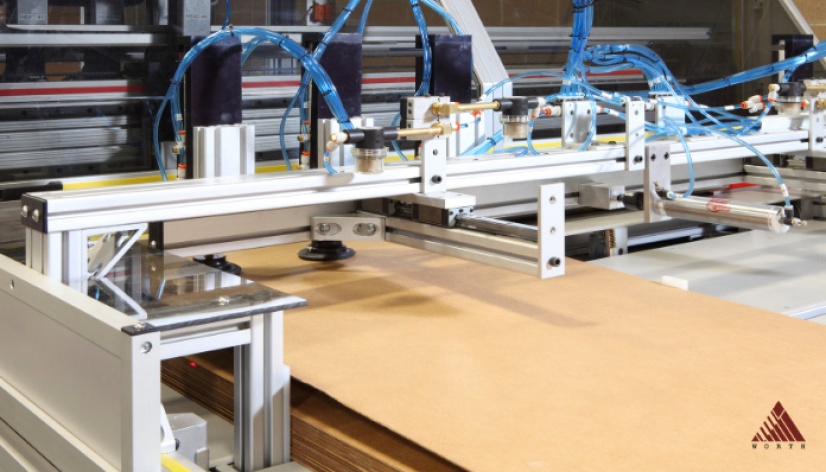
The manufacturing process begins at the corrugator, a large industrial machine that takes rolls of kraft paper and transforms them into sheets of corrugated board. The fluting medium is heated, shaped into waves, and glued between two liner papers using starch-based adhesives. Depending on the required strength, multiple layers may be bonded together, called ply. The resulting board is then cut, creased, and folded, either manually or by die-cutting machines, into the final corrugated packaging box.
The quality of a corrugated box is determined at every stage of this process: the GSM (grams per square metre) of the paper, the quality of the adhesive bond, the precision of the flute forming, and the accuracy of the die cutting. This is why the choice of corrugated box maker matters so deeply, a manufacturer cutting corners at any of these stages produces a box that looks acceptable but fails under real-world conditions.
Types of corrugated boxes
Not all corrugated boxes are built the same. The flute profile, the size and shape of the waves inside the board, determines the mechanical properties of the box. Here is a breakdown of the most widely used types:
-
Single-wall corrugated boxes (3-ply): One layer of fluting between two liners. The most common and cost-effective option, suited for lightweight consumer goods, retail packaging, and general e-commerce shipments.
-
Double-wall corrugated boxes (5-ply): Two layers of fluting with three liner sheets. Significantly stronger, used for heavier items, appliances, industrial components, and goods requiring longer transit times.
-
Triple-wall corrugated boxes (7-ply): Three fluting layers for maximum strength and rigidity. Typically used for heavy machinery, bulk industrial goods, and export crates where stacking loads are extreme.
-
Die-cut boxes: Custom-shaped using precision die-cutting tools. Ideal for branded retail packaging, product-specific inserts, and display packaging where aesthetics matter as much as protection.
-
RSC (Regular Slotted Container): The standard workhorse box, four flaps that meet in the middle when closed. Widely used across industries for its simplicity, efficiency, and stackability.
-
Full Overlap Slotted Container (FOL): Outer flaps fully overlap, offering extra resistance to rough handling. Often used for heavy goods and export applications.
-
Telescopic boxes: Two-piece boxes where one part slides over the other. Common in garment packaging, electronics, and premium product delivery.
Selecting the right type of corrugated box depends on the product's weight, fragility, transit distance, and storage conditions. A good corrugated box manufacturer will guide you through this selection based on your specific use case rather than simply offering whatever is easiest to produce.
Looking for the right corrugated box type for your product? Talk to our packaging experts at Worth Peripherals and get a recommendation in hours!
Industries that depend on corrugated packaging boxes
The reach of corrugated packaging is enormous. It is not a niche material, it is the dominant medium through which physical commerce moves.
E-commerce and direct-to-consumer brands rely on corrugated boxes for the last-mile delivery of almost everything sold online. The corrugated box is often the first physical touchpoint a customer has with a brand, making print quality and structural integrity equally important. The FMCG sector, food, personal care, household products, uses corrugated packaging at every stage of the supply chain, from factory floor to distribution centre to retail shelf. The pharmaceutical industry demands boxes that meet exacting cleanliness and dimensional standards, as medicines and medical devices must reach end-users without compromise. Electronics manufacturers require corrugated packaging boxes with anti-static properties and precision-cut inserts that hold fragile components without movement during transit.
Agriculture and horticulture depend heavily on corrugated boxes for the export of fresh produce, where ventilated flute designs allow air circulation and maintain freshness. The automotive and engineering sectors use heavy-duty double- and triple-wall corrugated boxes to ship components that cannot tolerate vibration or impact damage. Across all of these sectors, the corrugated box is not a commodity, it is a critical piece of infrastructure.
What to look for in a corrugated box maker?
Choosing between corrugated box manufacturers is not simply a matter of comparing price per box. Several factors determine whether a supplier becomes a long-term partner or a recurring problem:
-
Raw material quality: The paper grades used, both for liners and fluting medium, directly determine burst strength, compression resistance, and moisture tolerance. Always ask for BF (Bursting Factor) and BCT (Box Compression Test) ratings.
-
Manufacturing precision: Dimensional accuracy matters enormously in automated packing lines. A box that is 3mm wider than specified can jam machinery and create costly downtime.
-
Minimum order quantities (MOQs) and flexibility: Businesses at different stages of growth have different needs. A good corrugated box manufacturer should offer flexibility, not demand that you hold six months of inventory to get a reasonable price.
-
Turnaround time and logistics reliability: Packaging is consumable. Running out of boxes halts your operation. A manufacturer's ability to deliver consistently on committed lead times is as important as the product itself.
-
Print and customisation capability: As brand experience becomes a competitive differentiator, the ability to produce high-quality flexo or offset printing on corrugated cardboard boxes, with accurate colour reproduction, is a genuine advantage.
-
Sustainability credentials: With increasing regulatory and consumer pressure around packaging waste, manufacturers who use recycled content, operate efficient processes, and offer recyclable outputs are de-risking your supply chain.
-
Certifications and compliance: ISO certification, food-grade compliance, and export-standard packaging are non-negotiable for many industries. Verify these before onboarding any supplier.
Does your corrugated box supplier support you with these features? If not, talk to our packaging experts today!
The Indian corrugated packaging market
India's corrugated packaging sector is among the fastest-growing in the world, and the numbers reflect the country's expanding manufacturing and e-commerce base. According to IMARC Group, the Indian corrugated box market was valued at approximately USD 3.5 billion and is projected to grow at a CAGR of over 7% through the next several years, driven by growth in organised retail, pharmaceutical exports, and the explosion of e-commerce logistics.
On the sustainability front, corrugated cardboard boxes have a compelling story. According to the Confederation of Indian Industry's packaging sustainability data, corrugated packaging is one of the most recycled materials in the country, with recovery rates significantly higher than plastic packaging alternatives. For businesses under pressure to reduce their environmental footprint, switching to high-quality corrugated packaging boxes is one of the most immediately actionable steps available.
This growth trajectory also means that the market is increasingly competitive, and that the gap in quality between the best and worst corrugated box manufacturers has never been wider. Businesses that choose suppliers on price alone often find themselves absorbing the cost of damaged goods, failed shipments, and brand damage that far exceeds any per-box savings.
Top manufacturing companies of corrugated boxes in India
India has a robust base of corrugated box manufacturers ranging from large integrated paper-and-packaging conglomerates to specialised regional producers. The organised segment includes companies with automated corrugators, in-house printing presses, and dedicated quality control infrastructure. The unorganised segment, small job shops and local fabricators, remains large but increasingly unable to meet the compliance, consistency, and capacity requirements of modern businesses.
When businesses across sectors look for who manufactures corrugated boxes in India at a quality level suitable for export, e-commerce, or regulated industries, they typically evaluate suppliers on a combination of capacity, certifications, lead times, and customisation capability. Among the names that consistently meet these standards for businesses across the country is Worth Peripherals, a manufacturer with a track record of supplying corrugated packaging to clients in FMCG, pharmaceuticals, electronics, and e-commerce.
The best manufacturers in this space share common characteristics: consistent paper sourcing, modern corrugating machinery, reliable delivery infrastructure, and a willingness to work collaboratively on pack design rather than simply fulfilling generic orders.
Why Worth Peripherals is one of the leading corrugated box manufacturers in India
Worth Peripherals has built its reputation on being the most reliable corrugated box manufacturer. For businesses that have experienced the downstream cost of packaging failure, returned shipments, damaged goods, compliance failures, reliability has a clear monetary value.
What sets Worth Peripherals apart as a corrugated box maker:
-
A full range of corrugated packaging boxes including single-wall, double-wall, and triple-wall configurations to suit products of every weight class and fragility level
-
In-house multi-colour printing capability for custom branded corrugated cardboard boxes, with accurate colour reproduction and clean finish
-
Flexible order quantities that serve both growing businesses and established enterprises with large-volume requirements
-
Stringent quality checks at every stage of production, from incoming paper rolls to finished box dimensions and compression ratings
-
A responsive team that understands packaging as a business decision, not just a manufacturing task
Make the switch to a packaging partner that treats your supply chain with the seriousness it deserves. Contact Worth Peripherals today for a quote, a sample, or simply a conversation about what your packaging should be doing for your business.
FAQs about corrugated boxes
1. What is a corrugated box?
A corrugated box is a packaging container constructed from corrugated board, a layered material comprising one or more fluted (wave-shaped) paper sheets bonded between flat liner sheets. The fluted structure creates a series of arches that distribute load and absorb impact, giving corrugated boxes exceptional strength relative to their weight. They are the most widely used form of industrial and commercial packaging globally.
2. Who are the top manufacturing companies of corrugated boxes in India?
India has a well-developed corrugated box manufacturing sector spanning large integrated players and specialised regional manufacturers. Companies that consistently rank among the most reliable include those with modern automated corrugating lines, in-house printing capability, quality certifications, and proven delivery performance across sectors like e-commerce, FMCG, pharmaceuticals, and electronics. Worth Peripherals is recognised as one of the leading corrugated box manufacturers in the region, serving clients across multiple industries with a full range of single-wall, double-wall, and custom-printed corrugated packaging boxes.
3. Who manufactures corrugated boxes in India?
Corrugated boxes in India are manufactured by a mix of large, integrated paper-and-packaging companies and smaller specialised producers. The organised sector, which includes manufacturers with certified facilities, modern machinery, and consistent quality control, is best represented by companies like Worth Peripherals, which combine manufacturing scale with the flexibility to serve diverse industry needs. For businesses requiring reliable, high-quality corrugated packaging at competitive volumes, engaging with an established corrugated box maker in the organised segment is strongly recommended.
4. What are the types of corrugated boxes?
The main types of corrugated boxes are classified by wall construction and structural design. By wall construction: single-wall (3-ply), double-wall (5-ply), and triple-wall (7-ply), each progressively stronger and suited to heavier or more demanding applications. By structural design: Regular Slotted Container (RSC), Full Overlap Slotted Container (FOL), die-cut boxes, telescopic boxes, and half-slotted containers. The right type depends on the product's weight, fragility, transit conditions, and storage requirements. A qualified corrugated box manufacturer will help you identify the optimal specification for your application.